Keep your property company's books. Get its filings ready.
Upload your bank statements and review the categories the software suggests. It keeps proper double-entry books, works out the Corporation Tax figures, and prepares the accounts and tax return for you or your accountant to file.
Free during early access. No card, no password. Made for UK limited companies that let property.
Upload statements
CSV, OFX, QFX or PDF from the company's bank accounts.
Review the suggestions
Approve or change the category suggested for each payment.
Approve the pack
The accounts and Corporation Tax figures, ready for you or your accountant to file.
- Entries cannot be edited
- A mistake is put right with a reversing entry, and every change is logged.
- Every row is explained
- A row that cannot be read is reported, never quietly dropped.
- Approved packs are locked
- What you file is exactly what you approved.
- No password, no card
- An account takes an email address and a code, and nothing is charged during early access.
Made for property companies
UK private limited companies whose business is letting property, whether buy-to-let flats and houses or houses in multiple occupation. Other kinds of company, and other kinds of business, are not covered.
Read about buy-to-let company accounts and HMO company bookkeeping, or see everything it does and how it works.
From bank statement to filing pack
Bring in your statements
Upload CSV, OFX or PDF statements from the company's bank accounts. Every row is checked and explained. A row that cannot be read is reported, never quietly dropped.
Review the suggestions
Your own rules, what the company did before and an AI model suggest a category for each payment. Anything it is unsure of waits in a review queue for you to decide.
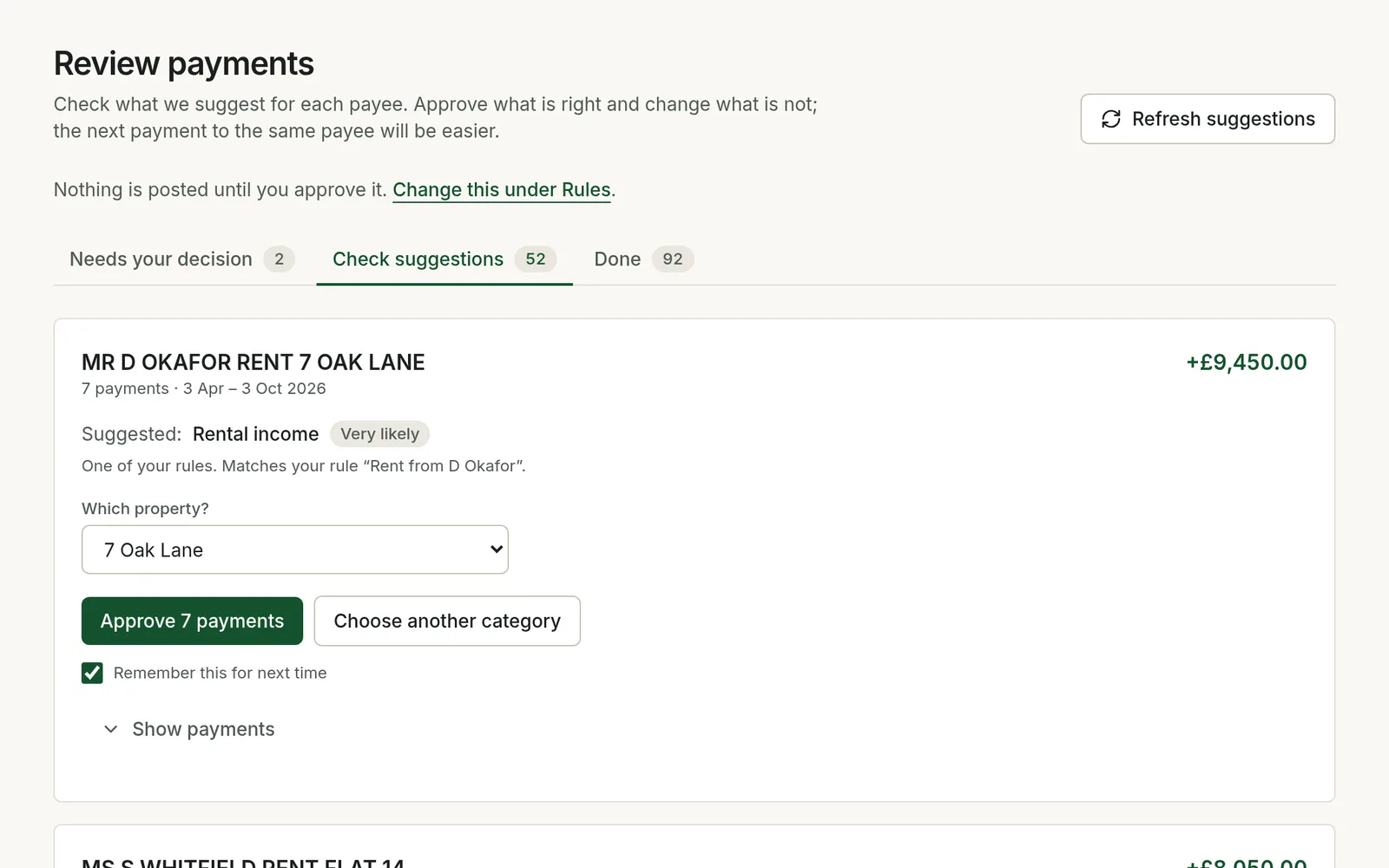
The review queue. Each payee has a suggestion and the reason for it, and nothing is posted until you approve it. Example data. Check the books
Entries are double-entry and cannot be edited later. A mistake is put right with a reversing entry, and every change is logged. Reports show the trial balance, profit and loss, balance sheet and the result for each property.
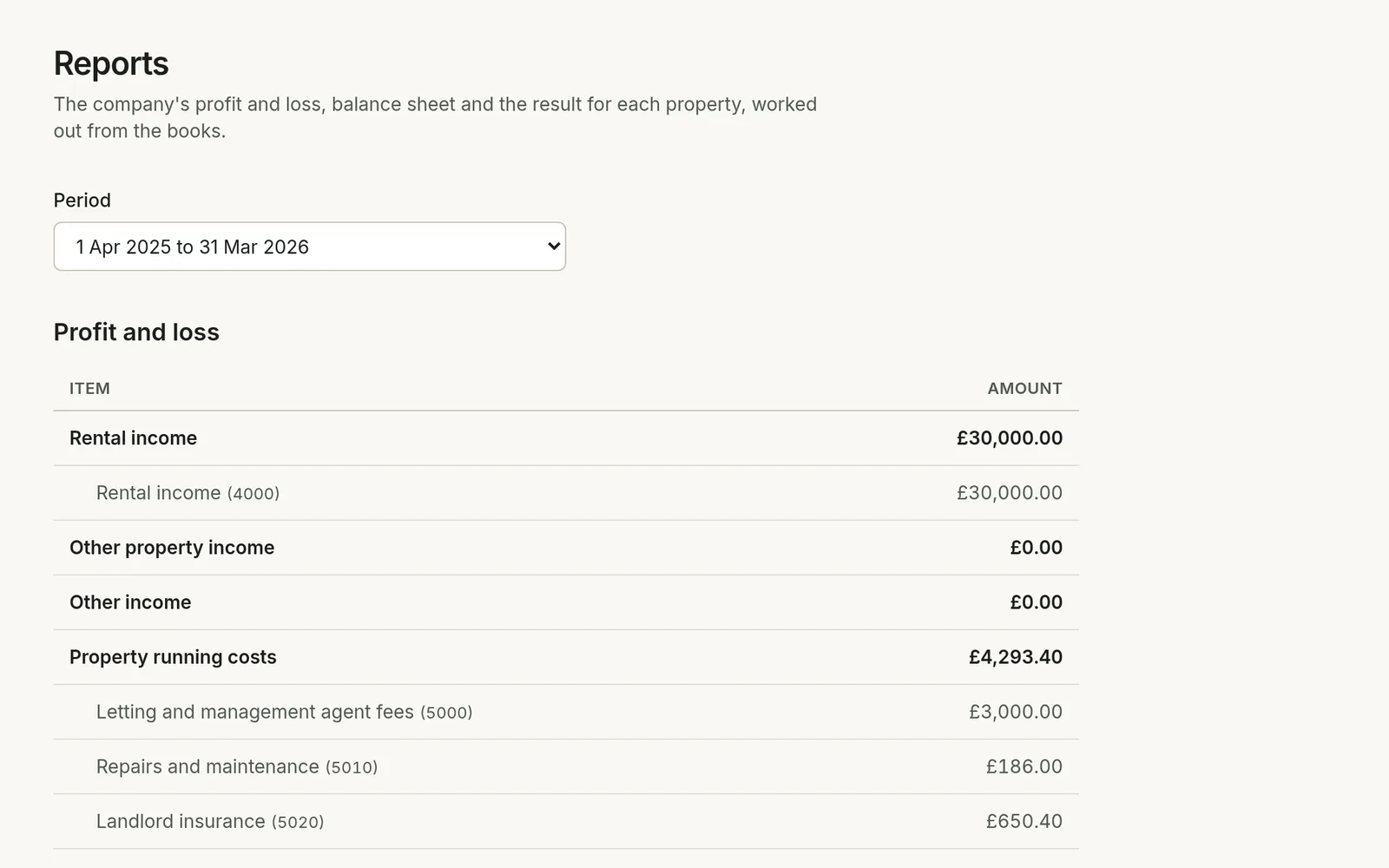
The profit and loss account, worked out from the books. Example data. See the tax
Corporation Tax is worked out from the books at the rates in force for the period, and set out as the boxes of the company tax return (CT600).
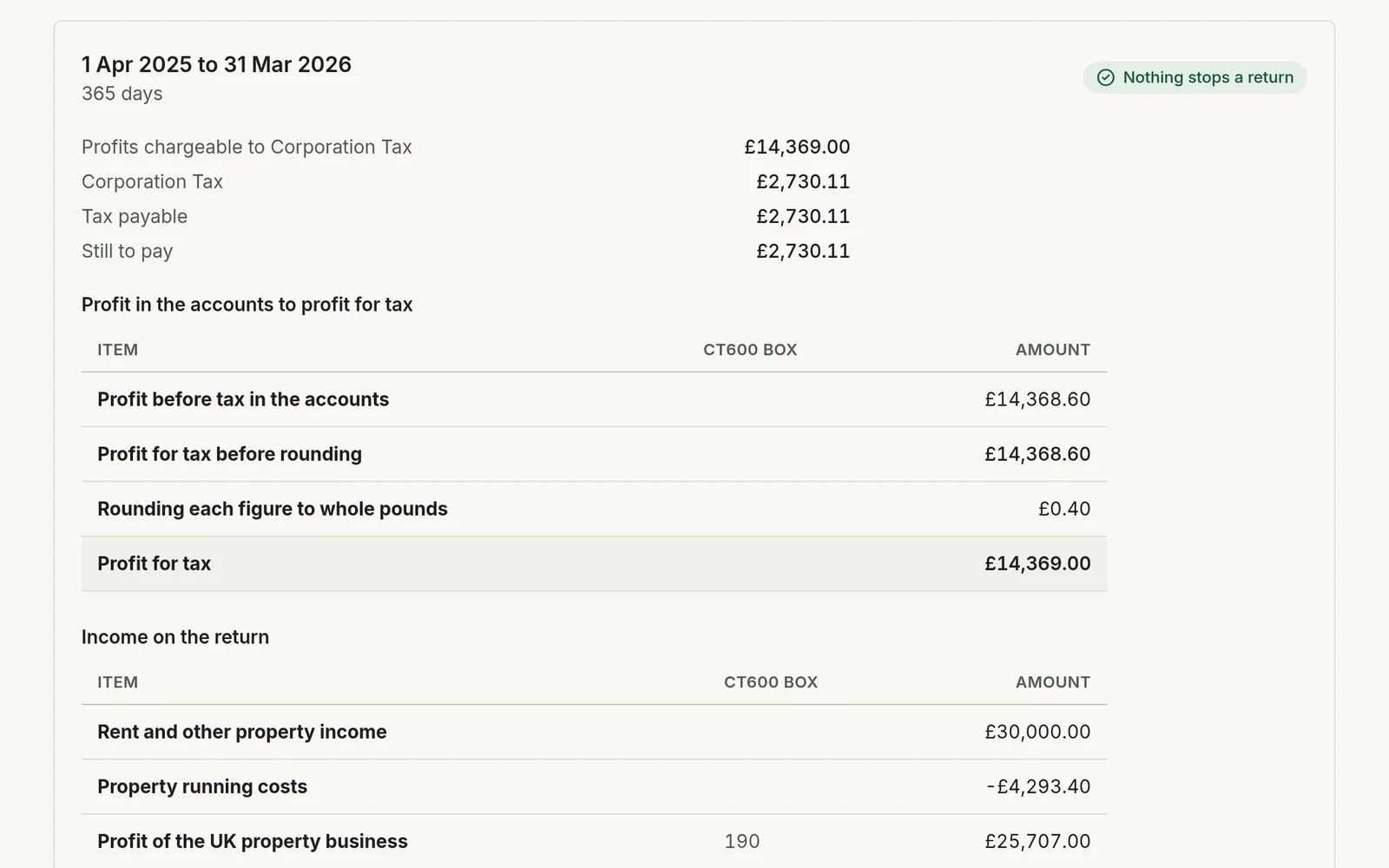
Corporation Tax for one period, worked out from the books and set out as the boxes of the CT600. Example data. Approve a filing pack
The accounts and the tax figures are put together as a pack. An owner approves it, and its files are then locked: what you file is exactly what you approved.
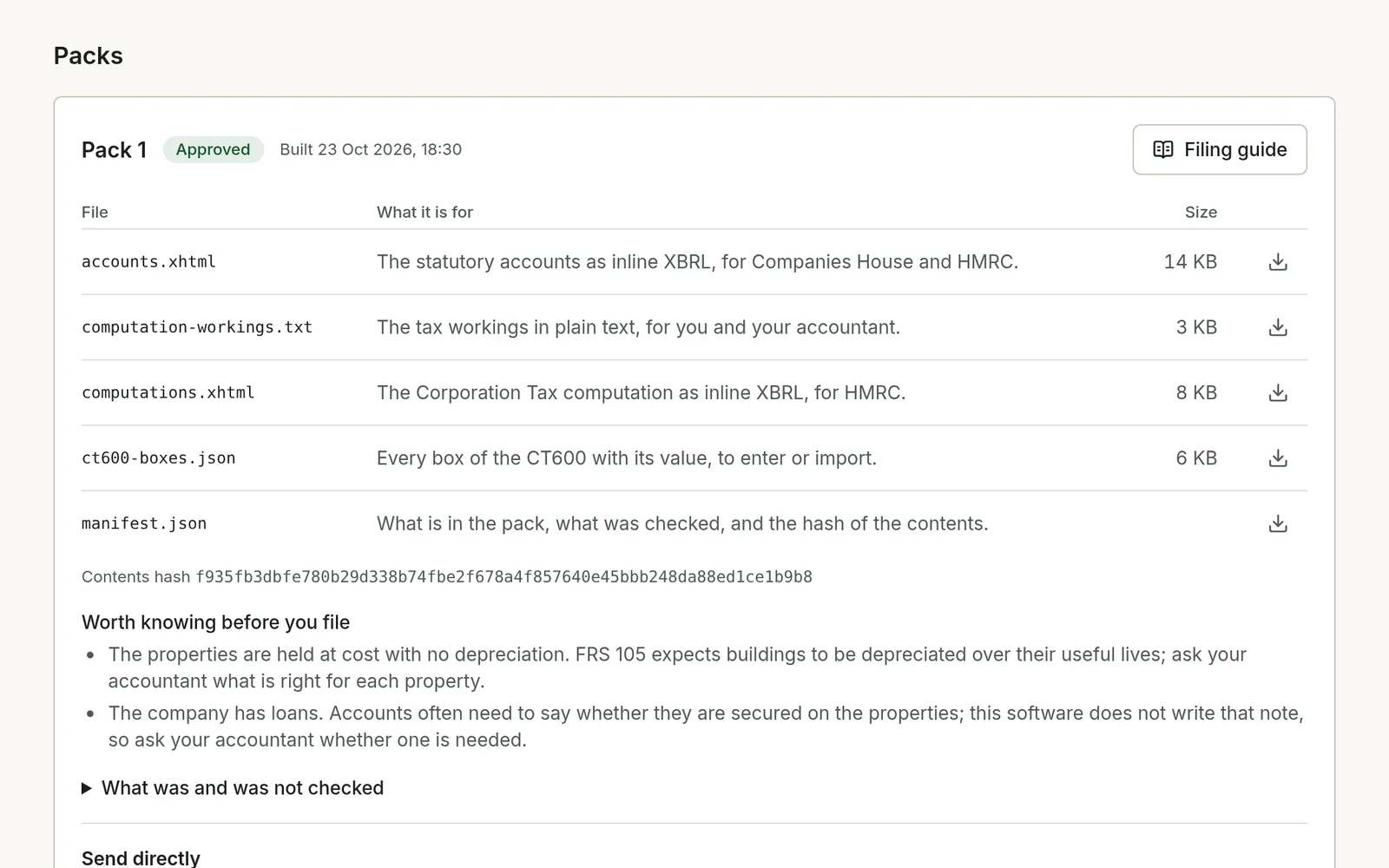
An approved filing pack and the files in it. Example data. Keep to your deadlines
Deadlines for the accounts, the tax payment, the return and the confirmation statement are worked out and tracked. Each approved pack comes with a step-by-step guide and a bundle of files for filing on the official services.
Try it with one bank statement
Upload a statement and see the books, the reports and the tax figures it makes. It is free during early access, and nothing is filed on your behalf.
What it is not
It is not an accountancy firm and does not replace an accountant.
No accountant has reviewed it yet.
It does not file anything on its own.
You, or your accountant, file on the official services.
It is not registered with HMRC or Companies House.
It makes micro-entity (FRS 105) accounts only.
Questions people ask first
Does it file my accounts and tax return?
No. It does not file anything on its own. It prepares the accounts, the CT600 values and the workings as a pack that an owner approves, and gives you a guide and a bundle of files for filing on the official services yourself or through your accountant.
What does the AI do?
It suggests a category for a payment. It does not work out tax or any other figure, and anything it is unsure about goes to a review queue for you. Transaction descriptions are sent to the model to do this.
Can I trust the tax figures?
They are worked out from your reviewed books by fixed rules, and checked against HMRC's published validation rules. But no accountant has reviewed the calculations, so treat them as a working draft and have them checked before you file.
What does it cost?
Nothing during early access. A price will be set, and published, before billing opens.
Try it on your own books
Free during early access. An account takes an email address and a code: there is no password, no card to enter, and nothing is charged.